

Be first to read the latest tech news, Industry Leader's Insights, and CIO interviews of medium and large enterprises exclusively from Retail Tech Insights
A featured contribution from Leadership Perspectives: a curated forum reserved for leaders nominated by our subscribers and vetted by the Retail Tech Insights Advisory Board.

Emily Black – Content Executive and Analyst at IMRG
How Did Online Retailers Cope with the Challenges of the Last Year?

Emily Black – Content Executive and Analyst at IMRG
Ecommerce retailers weren’t short of challenges in the last year. 2021 spanned a range of unchartered territory, such as heavy supply chain problems, changes in demand, stock issues, and the continuation of the pandemic. So, how has the market changed, and how can we use our learnings from 2021 to inform the year ahead?
One of the largest shifts in the ecommerce market was the move from shopping online only, to high street stores reopening in April 2021. Our graph, from IMRG’s digital dashboard, shows a reflection of this change in the data. For the first quarter of the year, Year on Year (YoY) revenue growth is up dramatically, however, as the stores reopened there is a drastic drop. This is because multichannel retailers were performing extremely well in the first few months of 2021, as their in-store customers moved online. When shops reopened, a portion of that traffic moved back to the stores, and online retailers saw negative growth for the first time that year. However, this dip was primarily being driven by the YoY measure being made difficult to read by the anomalous data of 2020, when online retail experienced its biggest growth ever, as a result of the UK lockdowns; some degree of realignment was inevitable.
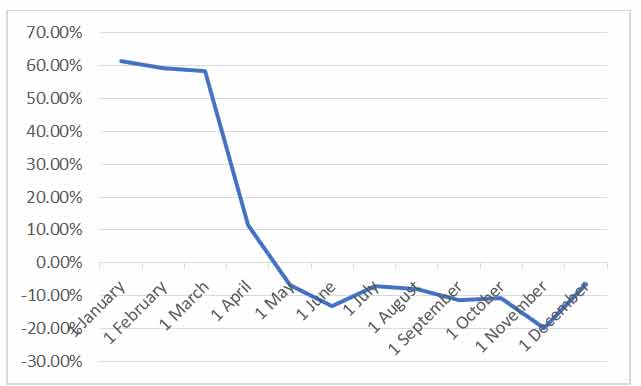
YoY Revenue Growth – 2021
Another challenge in 2021 was the supply chain issues which wreaked havoc across the entire year. Many retailers found that either they didn’t have the right stock at the right time of year, or it arrived very late. This placed pressure on retailers to clear out of seasonal stock, or get it in time for particular times—for example, Black Friday, which will be covered in the next paragraph. It is thought that the raised cost of acquiring stock (due to higher costs for HGV drivers—which were down one third during the year—and the cost of the shipping containers, which increased up to four-fold) created inflation. The rising cost of acquiring stocktherefore increased prices for the customers, and is reflected in the ABV, from IMRG’s digital dashboard. We can see the rising average amount being spent throughout the year, peaking at almost £150 in January, then dropping back down by December. At its highest, inflation caused a £40 increase in customer spend from January.

Monthly Average Basket Value – 2021
As mentioned, the challenges of this year impacted Black Friday, one of the most important times of year for retailers. The added pressure on stock meant that retailers were only selling what they had. IMRG concluded that Black Friday YoY growth was down -14.3%, which was the first time it’s been negative. This can be explained by the huge growth of 2020, when it was up 38%, which 2021 couldn’t rival. In order to shift as much stock as possible, retailers pushed their campaigns earlier and earlier into November, however this still couldn’t save the big day itself. On Black Friday, traffic was down -15.8% YoY, as retailers had been struggling to acquire traffic for the entire month, and in some cases the cost of ads and PPC increased tenfold. Retailers found themselves up against the odds for the majority of 2021, although it is unclear at the moment how these issues will settle down for 2022.
When we consider the pandemic as an anomaly, the data begins to make a bit more sense, and we can see that online retailers have prevailed despite adversity. The graph below shows that 2021 against 2020 reports poor growth in each category (+2.7% overall, our lowest ever recorded), but, when matched against 2019 we can see huge growth in ecommerce across the two year period. It’s not as bleak as we may have first thought, as there’s been a +39% increase in the market (our highest ever recorded). The following graph shows this difference in four categories IMRG tracks.
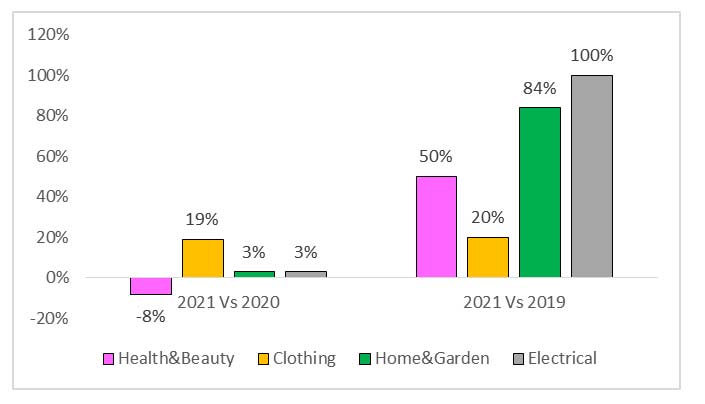
Revenue Growth in Categories – 2021 versus 2020, and 2019
Retailers came up against continual supply chain delays, and the added competition of the high streets reopening in 2021. Despite this, it can be considered a successful 2021 for ecommerce, with the two year period looking highly positive overall.
